42,140 gas boilers
Each one legally requires a Gas Safe registered engineer for any work on the gas side, and an annual service to keep most manufacturer warranties valid.
Tonbridge runs almost entirely on gas, its water is genuinely hard, and its housing stock spans Victorian terraces to post-war estates. Here is what the local data says, what it means for your boiler and pipework, and who to call when something goes wrong.
The 2021 Census recorded the type of central heating in every household in England and Wales. In Tonbridge and Malling, the answer is overwhelmingly mains gas — more so than the country as a whole.
| Heating type | Households | Share | England & Wales |
|---|---|---|---|
| Mains gas only | 42,140 | 78.6% | 74% |
| Electric only | 3,409 | 6.4% | ~9% |
| Oil only | 1,550 | 2.9% | ~3% |
| Renewable energy only | 203 | 0.4% | <1% |
| No central heating | 549 | 1.0% | 1% |
| Other, or more than one type | 5,724 | 10.7% | — |
The final row is the balance of the 53,575 households once the named categories are subtracted, and covers tank or bottled gas, solid fuel, wood, district heat schemes and homes with two or more heating types. Percentages are rounded and may not total exactly 100%.
Two things stand out. First, Tonbridge and Malling is more gas-dependent than the national average — 78.6% of households run on mains gas alone, against 74% across England and Wales. In practical terms that is 42,140 gas boilers in the borough, every one of which needs an annual service by a Gas Safe registered engineer to stay safe and keep its manufacturer warranty intact.
Second, the outlying villages skew the picture. The 1,550 oil-heated homes are concentrated in properties off the gas grid around the edges of the borough — Shipbourne, Plaxtol and the smaller hamlets — where an oil-fired boiler and a tank are still the norm rather than the exception.
Each one legally requires a Gas Safe registered engineer for any work on the gas side, and an annual service to keep most manufacturer warranties valid.
Gas central heating means radiators and circulating water — and a system that accumulates magnetite sludge and limescale over its life unless it is flushed and dosed.
Off-grid properties in the surrounding villages run oil-fired boilers, with their own servicing, tank and pipework considerations.
Tonbridge is supplied by South East Water, which classifies its Kent supply as hard. Independent measurements across the company's Kent zones typically fall between 270 and 300 mg/l of calcium carbonate — comfortably inside the "hard" band, and among the harder water in the country.
That is a geology problem, not a water-company one. Rain filtering through the chalk and greensand of the North Downs and the Weald picks up dissolved calcium and magnesium on the way to the aquifer. It is perfectly safe to drink. It is not kind to heating systems.
When hard water is heated above roughly 60°C, the dissolved calcium comes back out of solution as limescale, and it does so on the hottest surface available — the heat exchanger in your boiler, or the element in an immersion heater. Scale is an insulator. A scaled heat exchanger has to burn more gas to move the same heat into the water, so efficiency falls and running costs rise. Left long enough, it causes kettling: the rumbling, boiling-kettle noise of water flashing to steam in the restricted passages of a scaled exchanger.
Rumbling or banging from the boiler when the heating fires. Radiators cold at the bottom but warm at the top. Hot water that runs lukewarm before it runs hot. Showerheads and tap aerators furring up faster than they should. Any of these is worth a look before winter rather than during it.
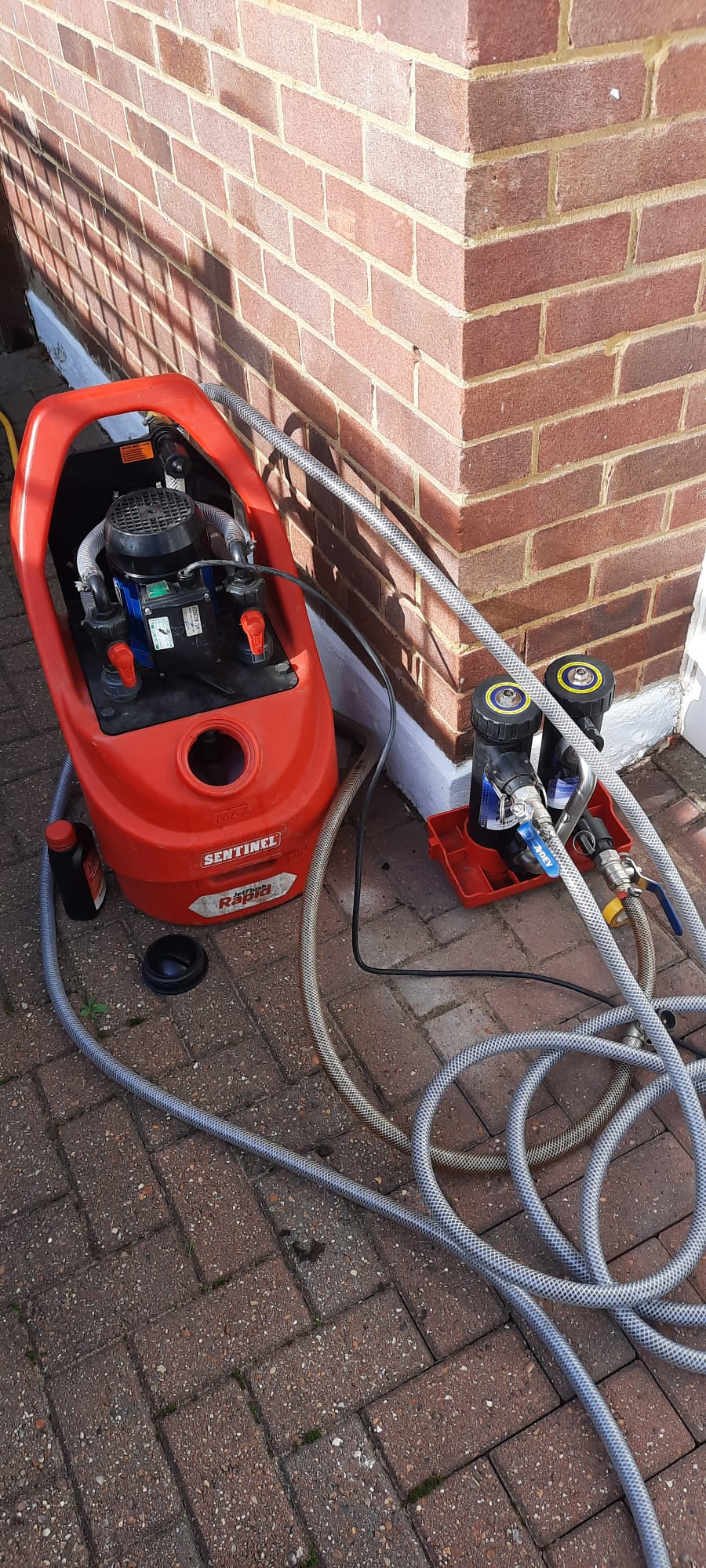
A pumped flush at high flow and low pressure to shift magnetite sludge and loose scale out of radiators and pipework. The usual fix for cold spots, slow warm-up and a system that never quite gets there.
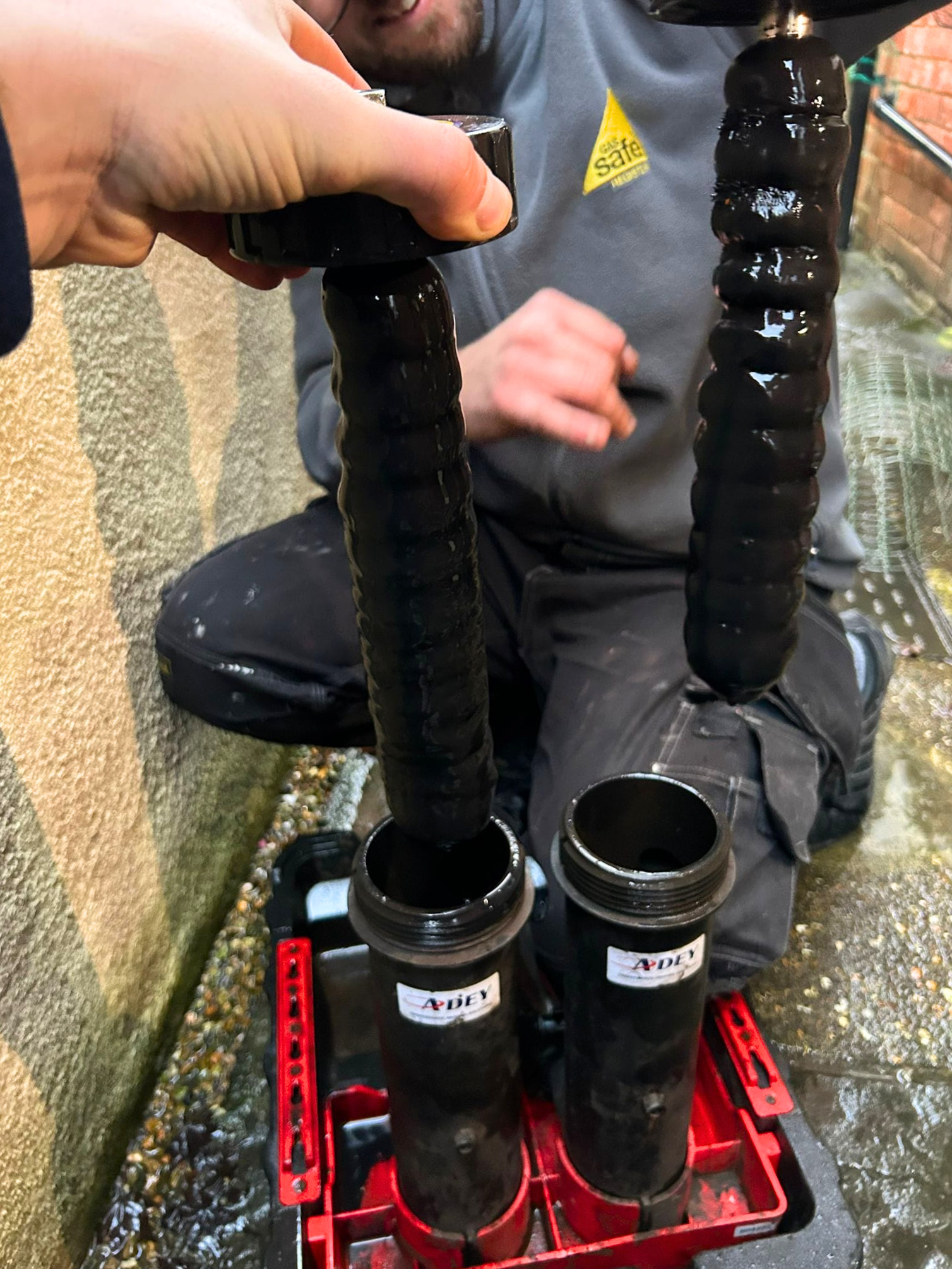
Fitted on the return to catch iron oxide before it settles in the boiler. Cheap insurance on a hard-water system, and a manufacturer requirement on many warranties.
Chemical inhibitor slows corrosion and scale formation inside the system. It depletes over time and after any drain-down, so it needs topping up — commonly missed.
On the mains cold feed, these limit scale forming downstream in combi boilers and cylinders. Worth considering in an area at this hardness level.
Tonbridge grew fast between 1881 and 1911, again after the war, and again in the last few decades. Each wave left behind a different kind of plumbing, and a different set of things that go wrong.
The terraces and villas that went up during the town's railway-era boom — the Douglas Road and Barden Park area, and the higher ground clear of the Medway floodplain. Solid walls, original service routes, and often decades of piecemeal alteration: microbore spurred off imperial pipe, boxed-in joints, and the occasional length of lead supply pipe still in service.
Trench Wood, Cage Green, Higham Wood and the other mass-built estates. Copper pipework and first- or second-generation central heating now reaching the end of its service life — pinhole leaks in ageing copper, tired gate valves, and open-vented systems with tanks in the loft that are well past their best.
Plastic push-fit, sealed systems, combis and unvented hot water cylinders. Fewer surprises behind the plasterboard, but unvented cylinders are a controlled service in their own right and legally require a separately qualified engineer to work on them.
Two local factors sit on top of that. Tonbridge and Malling has 61 conservation areas and around 1,400 listed buildings and structures — a high concentration by any standard. In a conservation area or on a listed building, where a flue terminates and how external pipework is routed stop being purely technical decisions and start involving the planning department.
And then there is the river. Tonbridge sits on the Medway, and the western side of the town remains designated floodplain. The 1968 flood led to the building of the Leigh Flood Storage Area upstream, but the town flooded again in 2013 and in December 2019. For plumbing, that matters in two ways: where boilers, controls and electrics are sited in properties at risk, and the fact that any heating system that has been under water needs a proper inspection rather than a hopeful restart.
Matthew holds Gas Safe registration, the unvented hot water cylinder qualification, NVQ Plumbing Levels 2 and 3, and Water Regulations certification — the combination the three eras above actually need.
With 42,140 gas-heated homes in the borough, the single most useful thing a Tonbridge homeowner can do is check the registration of whoever works on their boiler.
It is a legal requirement in the UK that anyone carrying out work on gas appliances is on the Gas Safe Register. It is not a trade body or a badge of quality — it is the statutory register, and working on gas without it is a criminal offence.
The reason the check matters is in the register's own investigation data: across investigations into gas work carried out by unregistered fitters, around two thirds has been found to be unsafe. The Health and Safety Executive has continued to prosecute unregistered gas work, and the consequences of getting it wrong are gas leaks, fires and carbon monoxide poisoning rather than a poor finish.
Every Gas Safe registered engineer carries an ID card with a photograph, a licence number and an expiry date, and the reverse lists exactly which categories of gas work they are qualified to do. You can verify any licence number at gassaferegister.co.uk or by calling 0800 408 5500. Ask to see it. A genuine engineer will expect you to.
Photo, licence number, expiry date on the front. The specific gas qualifications held on the back. No card, no gas work.
Most manufacturers require a yearly service to keep the warranty valid, and it is when wear and unsafe combustion get caught early.
An audible carbon monoxide alarm to BS EN 50291 in any room with a fuel-burning appliance. Inexpensive, and the only warning you get.
A hard-water heating system in Tonbridge, flushed and filtered. The second photograph is what came out of the magnetic filter afterwards — the iron oxide sludge and scale that had been circulating through the radiators.
More jobs across Medway and Kent — boiler installs, first-fix pipework, unvented cylinders and shower valve replacements — are in the recent work gallery on the main site.
M B Plumbing & Heating is based in Medway and has covered Kent since 2001. Tonbridge sits within the regular coverage area, along with the villages around it.
Not listed? Tonbridge is one corner of a coverage area that runs across Medway and mid-Kent. Call and ask — if it is a job Matthew can get to, he will tell you straight away, and there is no charge for asking.
Boiler service, a leak, a power flush or a full heating install — tell Matthew what you need and you will get a straight answer and an honest price. No call-out fee, free estimates, and no job too small.
07929 544 856Every figure on this page comes from published data. Where a number is derived or approximate, it is described as such in the text.
Page published September 2026. Census figures are as at Census Day, 21 March 2021.